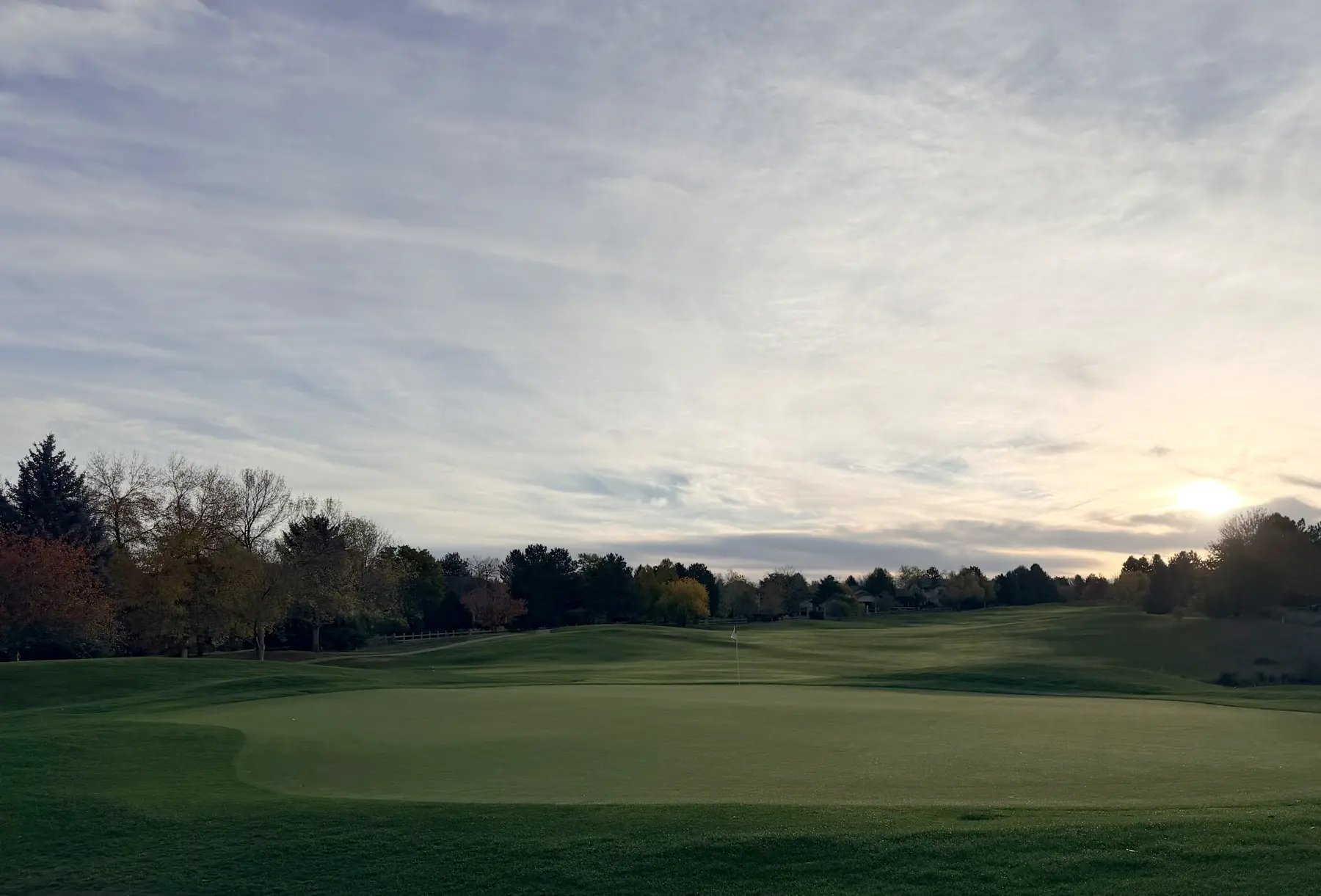
How fast are the greens today?
Film a putt.
Read the speed.
No ramp, no tape measure.
A green-speed meter in your phone
Coming soon to the App Store and Google Play.
How to measure
-

1
Hold the phone flat above the green
Hold it sideways, level at chest height, camera straight down. Keep still while the ball rolls.
-

2
Putt from the circle into the box
Set the ball in the START circle and putt it along the arrow so it stops inside the box.
-
3
Then putt it back the other way
Putt it back along the same line. Rolling both ways cancels out slope.
Misread, or just fast?
You run a putt five feet past and blame your read. Maybe your read was fine and the green is quick today. Speeds change by the day, the hour and the green. Know the speed and stop second-guessing.
<50%
Guessing the speed
In a study of 448 golfers at 29 courses, golfers named the right speed range for typical greens less than half the time. Low handicappers did only slightly better.
6 in
Too small to feel
Putting on two greens 6 inches apart in speed, golfers picked the faster one no better than a coin flip.
Most days
Slower by afternoon
On greens measured all season, speed at 2 pm was slower than at 7 am on almost every day. Know the speed today, not last week's.
Greens feel slow? Measure them. Then you'll know if it's the greens or the putter, and you can settle the argument in the clubhouse with a number.
Sources: Dest et al., Applied Turfgrass Science, 2010; Karcher, Nikolai & Calhoun, Golf Course Management, 2001; Morris, Nikolai & Frank, Michigan State University.
What one foot of speed does
Green speed is how far a ball rolls, in feet, when it starts at a set pace. It's also called the Stimp or the Roll. The same stroke rolls about 10% farther for every foot faster the green is. That sounds small, but it adds up.
8 ft
Lag putts
A 40-footer on a 10 runs 8 ft past on a 12.A putt that rolls out 40 feet on a green speed of 10 rolls 44 feet on an 11 and 48 feet on a 12. That's 8 feet past the hole, and a three-putt waiting.
4 ft
Short putts
Two feet faster turns a tap-in into a 4-footer back.Hit a 10-footer firmly enough to finish a foot and a half past, and two feet of extra speed leaves you almost four feet coming back instead.
10%
Break
Each foot faster breaks about 10% more.For every 1 ft of speed the ball will break 10% more. Depending on distance and slope that's an extra ball or a cup of offset.
Why faster greens break more
On a fast green you hit softer, so the ball rolls slower and the slope has longer to pull it. Two feet quicker needs about 20% more break. Saturday's read misses low on Sunday.
How it works
No set pace needed. OpenRoll measures how fast your putt slows down and works out the green speed from that.
Every reading is saved
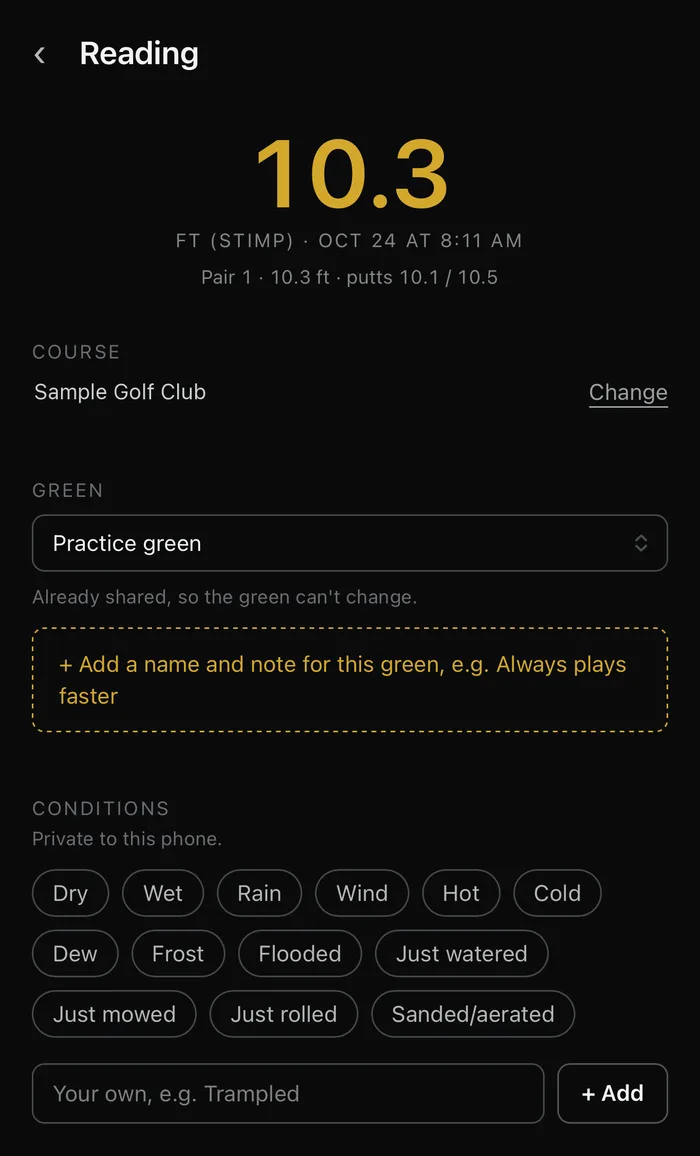
Each reading saves the speed, course and green. Tag conditions like dew or just mowed. On a bumpy green, roll more pairs. The middle result counts, so one bad putt won't skew it.
Where to measure
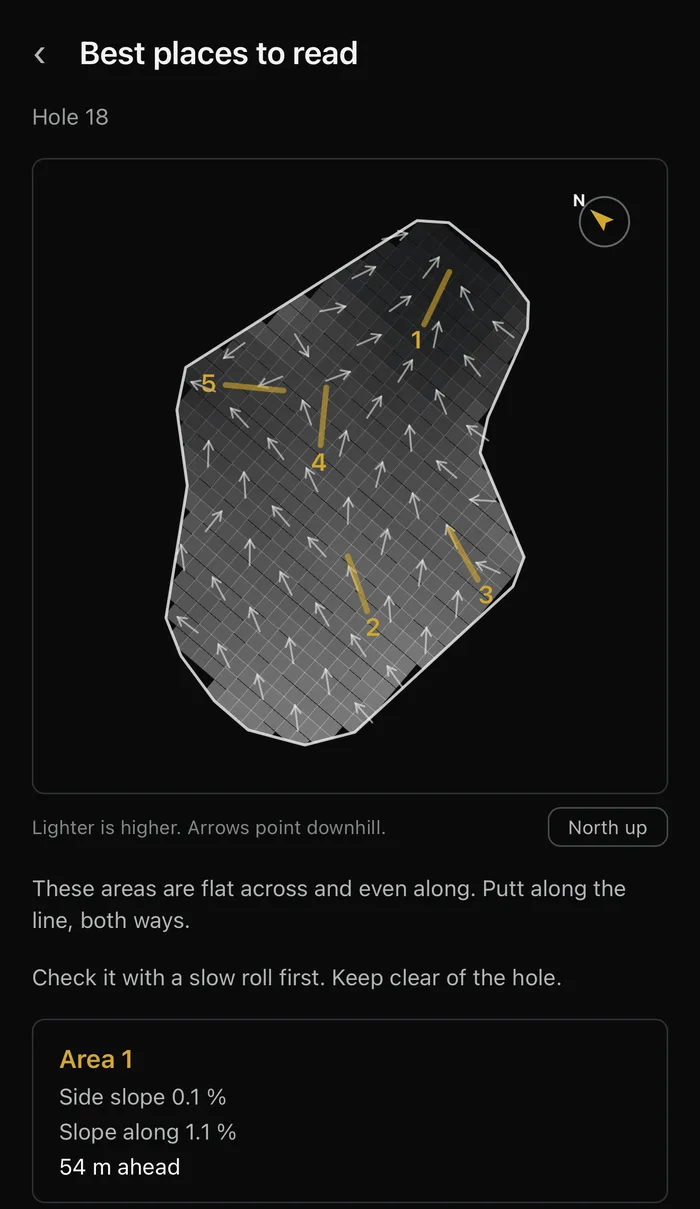
Pick a flat, even stretch. Rolling both ways cancels slope along the line, but slope across it skews the reading. The app suggests up to five good lines per green, and the course's own lines come first. The map needs a connection; measuring doesn't.

Get the app
Read green speed on any course from your phone.
Bring OpenRoll to your golf course
For superintendents and golf shops who want clearer communication about green speed, OpenRoll helps you share today's speed with golfers and keep targets consistent.
See what OpenRoll can doWorks offline
Measuring works offline, and the app names your course without a signal. Elevation maps need a connection.
Privacy
No account. Readings stay on your phone; course readings are shared anonymously unless you turn it off. Privacy policy.
Three free measurements
Three free measurements, then a one-time purchase for unlimited. No subscription.
Mind the Rules of Golf
Rolling a ball to test a green during a round is a penalty. Measure on the practice green, or outside a competition round.